How Do You Choose the Right Odoo Partner in Germany?
26.06.2026
If you are searching for an Odoo partner in Germany, you have probably already discovered that the software itself is the easy part. Odoo is genuinely strong ERP software. It’s flexible, modular, and used by mid-sized companies across manufacturing, logistics, and services. The hard part is getting it to work the way you need it to be for your business and at the same time fulfills German accounting, tax, and audit requirements demand. That is where the right implementation partner stops being optional and starts being the deciding factor in whether your project succeeds or quietly becomes another expensive cautionary tale.
I have spent 23 years inside German industrial and trading companies, including eight years managing an ETRM platform processing close to two billion euros in annual trade volume. I have seen what happens when a system is implemented without local compliance built in from day one, and I have seen what it takes to do it properly. With that in mind, I write this guide to help you understand what to look for.
Is Odoo Used in Germany?
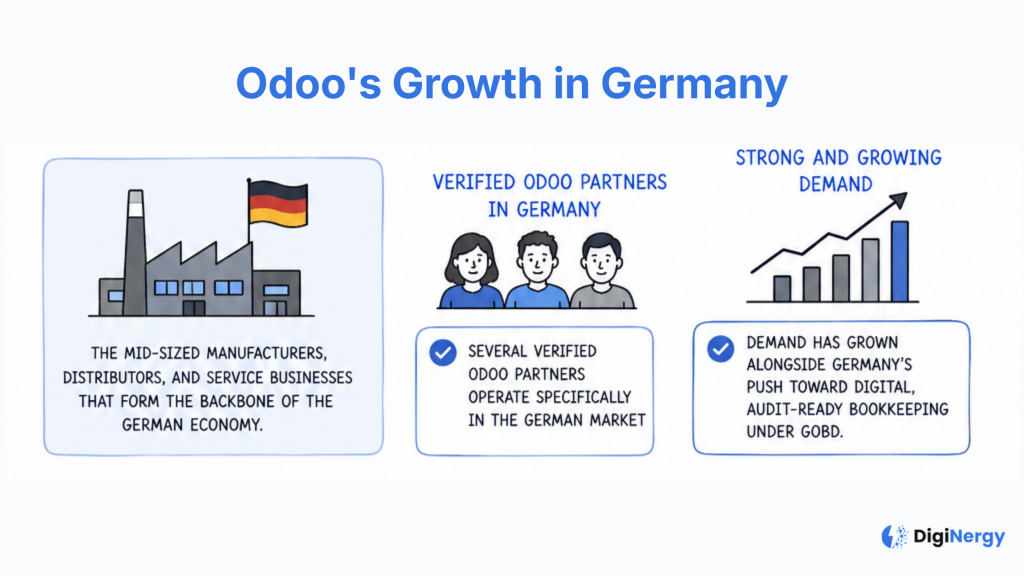
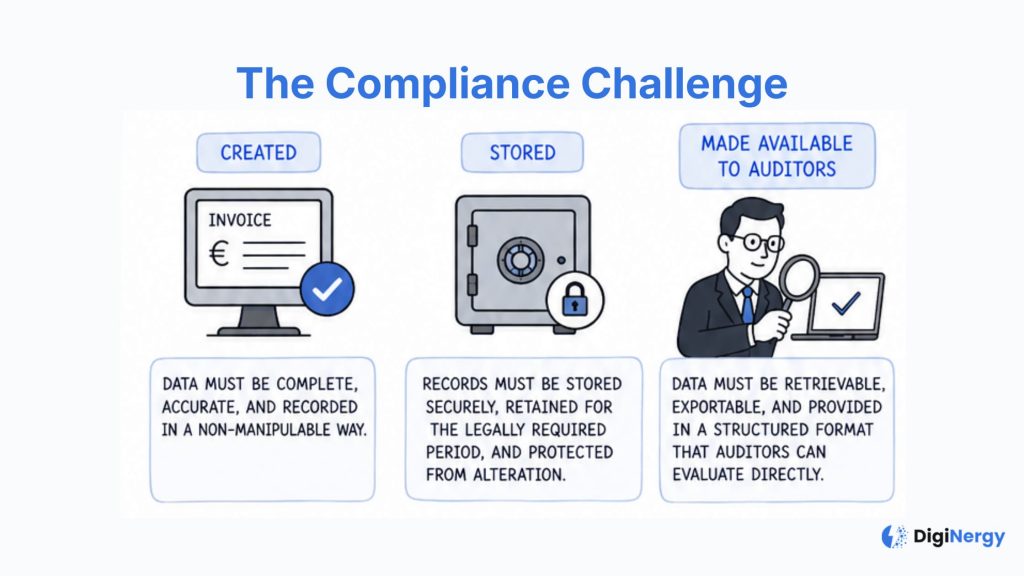
Yes, and increasingly so. Odoo has become one of the leading ERP choices for German Mittelstand companies — the mid-sized manufacturers, distributors, and service businesses that form the backbone of the German economy. Several verified Odoo partners operate specifically in the German market, and demand has grown alongside Germany’s push toward digital, audit-ready bookkeeping under GoBD. But adoption in Germany comes with a layer of complexity that does not exist in most other markets, because German accounting law is unusually prescriptive about how electronic records must be created, stored, and made available to auditors.
Why German Compliance Changes the Odoo Topic
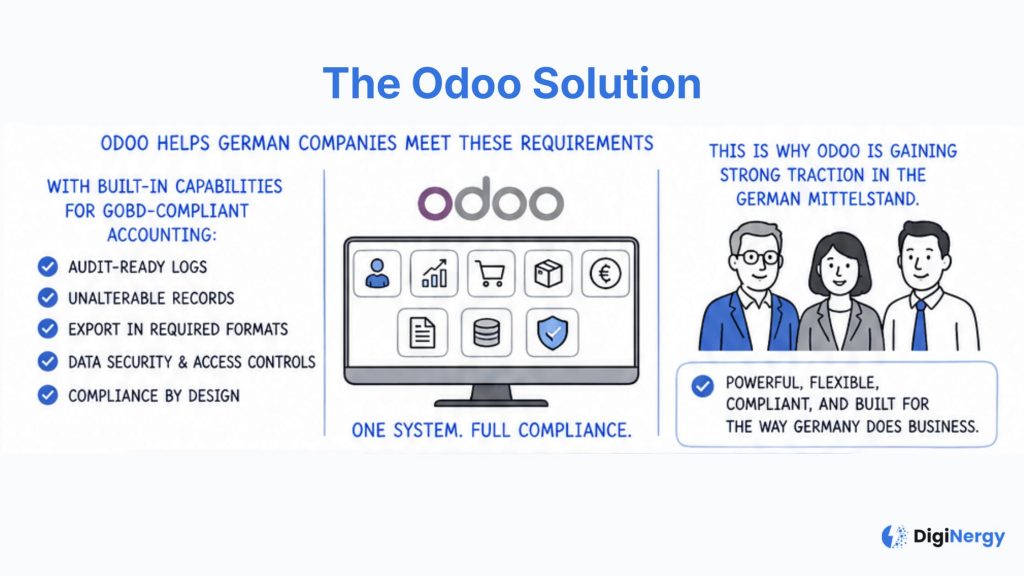
Odoo does not include native support for the German compliance stack out of the box. That is not a flaw — Odoo is built as an internationally oriented platform, and Germany’s accounting requirements are genuinely unusual by global standards. But it does mean that an implementation without the right configuration will work fine for daily operations and then fail at the moment that matters most: the audit, the year-end close, or the handover to your Steuerberater.
Three requirements come up in nearly every German Odoo implementation:
→ GoBD compliance: the legal standard governing how electronic bookkeeping records must be created, retained, and made accessible to tax authorities. It demands a complete, unbroken audit trail — not just accurate numbers, but documented proof of how those numbers came to exist.
→ DATEV integration: over 70% of German tax advisors work inside the DATEV ecosystem. Without a clean, automated export from Odoo into DATEV format, your accountant ends up rebuilding your books manually every month — which defeats much of the point of having an ERP at all.
→ SKR03 / SKR04 chart of accounts: Germany uses standardised account frameworks that your Steuerberater expects by default. Configuring Odoo with a generic or improvised chart of accounts creates friction at every single reporting cycle.
None of these are exotic requirements. They are simply non-negotiable in the German market — and they are exactly the kind of detail that separates an Odoo partner who has done this before from one who is learning on your project.
What an Odoo Partner in Germany Should Deliver
When you are evaluating partners, the conversation should move past “we configure Odoo” fairly quickly. Here is what a genuinely capable partner brings to the table:
→ Direct experience with your Steuerberater’s workflow. A good partner configures Odoo so your tax advisor receives clean, structured, DATEV-ready records — not files that require manual rework before they can be used.
→ GoBD-ready audit trails from day one. Retrofitting compliance after go-live is significantly more expensive than building it into the implementation from the start.
→ GDPR-compliant hosting, ideally based in Germany. Data residency matters for many German businesses, particularly in regulated industries.
→ Industry-specific configuration, not a generic template. A railway fleet operator, an energy trading company, and a discrete manufacturer need fundamentally different module configurations — a partner without cross-industry depth tends to apply the same template everywhere.
Which Country Is Odoo Based In, and Does It Matter?
Odoo S.A. is headquartered in Belgium, and the platform was built with an internationally oriented design philosophy from the start. That global orientation is exactly why German-specific compliance is not native to the core product — and exactly why the implementation partner you choose matters more in Germany than it might in a market with simpler accounting rules. The platform itself is excellent. What determines your outcome is how well it is adapted to the legal and procedural environment you actually operate in.
Is Odoo 100% Free?
Odoo Community Edition is open source and free to use. But “free software” and “free implementation” are two very different things, particularly in Germany. Most businesses still need GoBD-compliant configuration, a DATEV connector (often a third-party module, since Odoo has no native DATEV interface), correct SKR03/SKR04 setup, and ongoing support, none of which come bundled with the free license. Realistic implementation costs for a properly compliant German setup typically start in the low five figures and scale with company complexity.
Odoo Enterprise adds licensing costs on top, but also a more complete out-of-box feature set, which can reduce the total customisation needed. The right comparison is never “free versus paid.” It is the total cost of a system that actually holds up under audit, versus the much larger cost of fixing one that doesn’t.
How this pans out in real life
At DigiNergy, we work with energy, rail, and manufacturing companies across Germany who need an ERP that is correct on the compliance side and genuinely usable on the operational side. That combination is harder to deliver than it sounds. We have seen Odoo implementations that were technically GoBD-compliant on paper but so cumbersome that staff built workarounds within weeks, which defeats the entire purpose of the audit trail.
Our approach starts with the process, not the software: mapping how your finance team, your Steuerberater, and your operational teams actually need data to move, and only then configuring Odoo around that reality. The result is a system your accountant can work with directly, an audit trail that holds up to scrutiny, and an operational tool your team actually wants to use — not one they route around.
Robin Sons is Founder and Managing Principal Consultant at DigiNergy, a boutique consultancy specialising in ERP implementation, AI automation, and compliance-ready systems for energy, rail, and industrial companies across Germany, Europe, and Asia.
Book a 30-minute conversation: https://calendly.com/robin_diginergy/30min
